
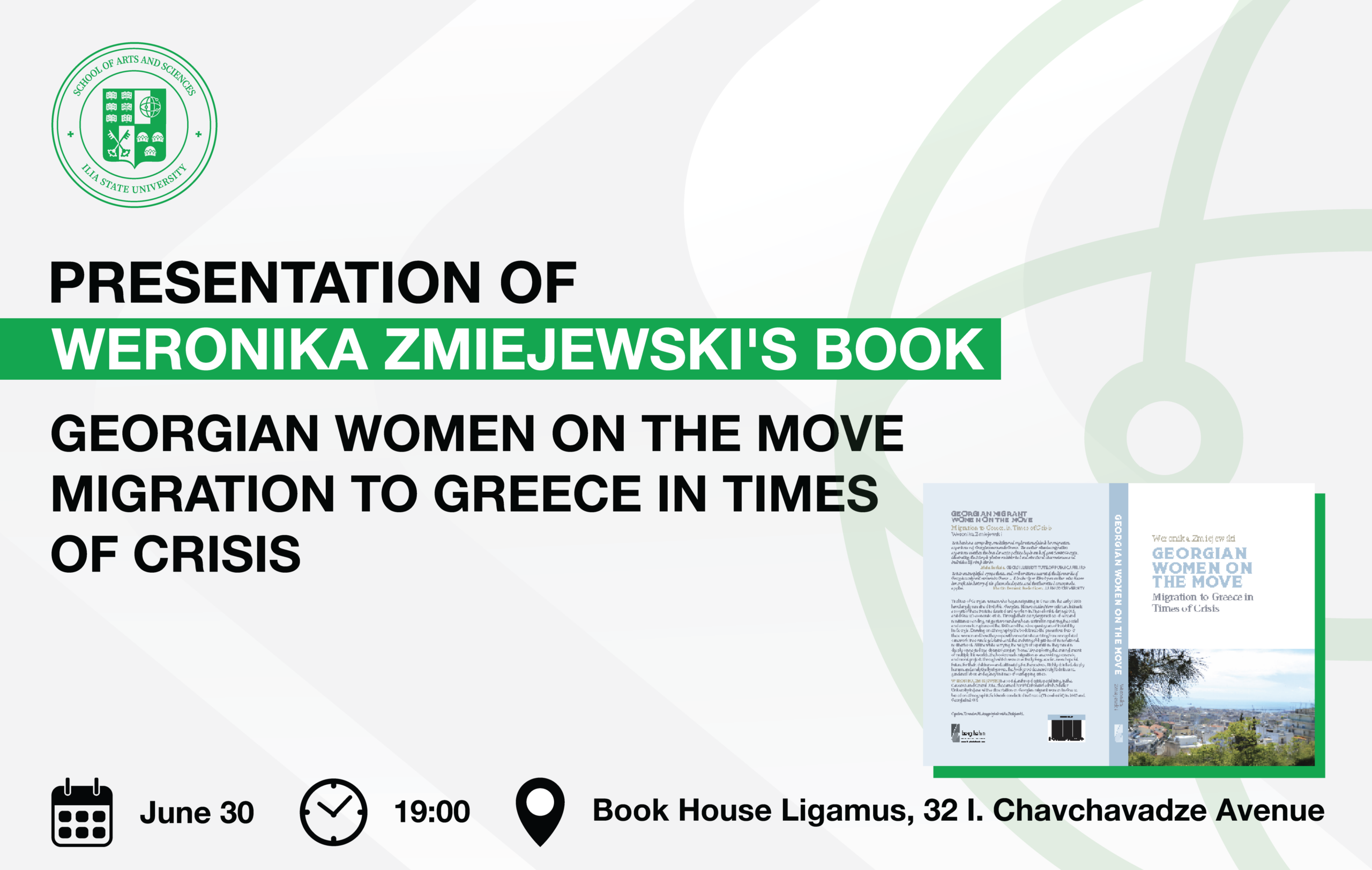
We are concluding this semester’s series of Anthropology Seminars with a presentation of Weronika Zmiejewski’s book — on Tuesday, June 30th, at 19:00 (Tbilisi time), at the “Ligamus” bookhouse.
Title of the book: Georgian Women on the Move – Migration to Greece in Times of Crisis
This book examines the migration of Georgian women to Greece from the mid-1990s to 2016. Drawing on multi-sited ethnographic fieldwork conducted in Thessaloniki in 2015 and in Georgia in 2016, it situates the life trajectories of Soviet-educated Georgian women within the broader context of two overlapping crises: the post-Soviet socio-economic transition in Georgia and the financial crisis that unfolded in Greece after 2009. Georgian migrant women develop diverse strategies to cope with the uncertainties arising from informal care work, insecure legal status, and the enduring obligations of transnational motherhood. Through their largely invisible care labor for elderly people, children, and persons with disabilities, Georgian women have become indispensable to the social reproduction of Greek middle- and upper-class households. At the same time, as carers and breadwinners for their families, they have contributed to repairing the social and economic ruptures of the 1990s and mitigating the effects of the prolonged instability that followed in Georgia.
A short bio:
Weronika Zmiejewski is a social anthropologist. She earned her PhD from Friedrich Schiller University Jena with a dissertation on Georgian migrant women in Greece. Since 2024, she has been conducting the FWF-funded postdoctoral project “Uncomfortable Ancestors – Challenging Commemoration: Central Asia in the Phonogrammarchiv’s Viennese WWII Recordings” (ESP 575-G) at the Austrian Academy of Sciences. Her current research focuses on the critical reappraisal of the Phonogrammarchiv’s Central Asian and Caucasian World War II recordings, exploring questions of (re-)circulation, commemoration, and archival legacies.