
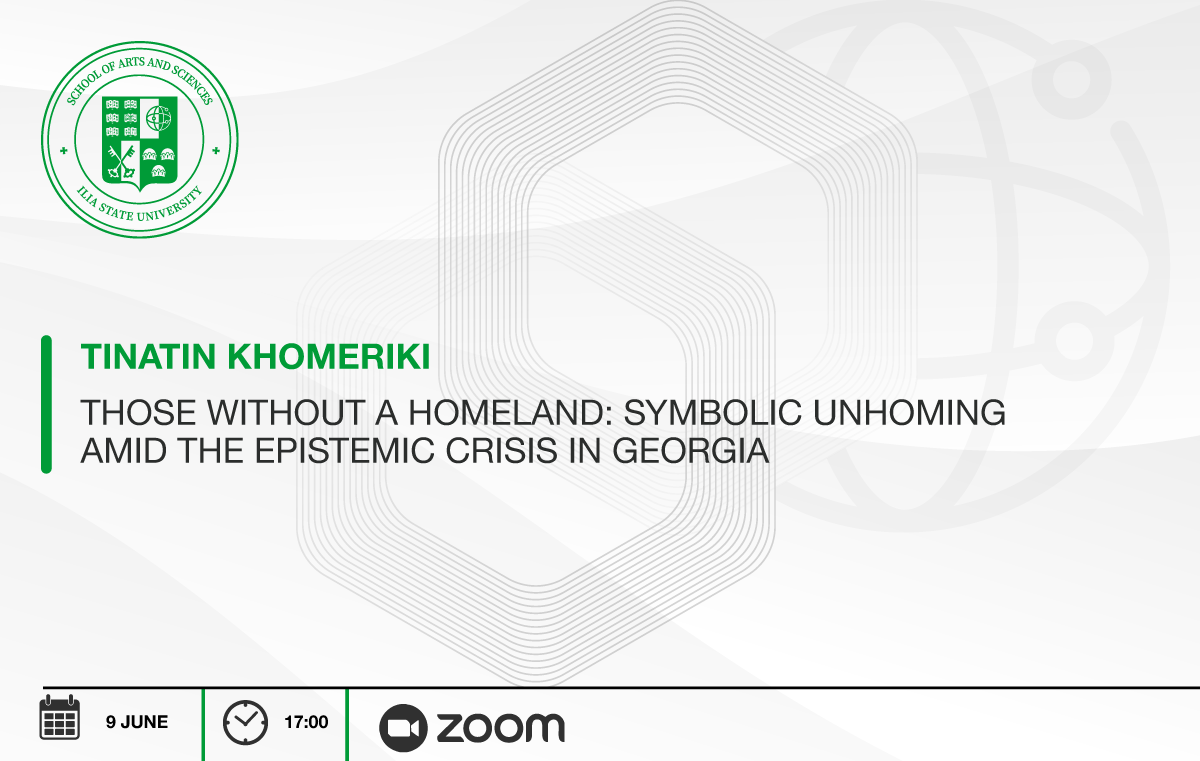
On June 9 at 17:00, Tinatin (Tiko) Khomeriki will deliver an online lecture “Those Without a Homeland: Symbolic Unhoming amid the Epistemic Crisis in Georgia”, organized by the Anthropology Research Center and the Doctoral program in Social and Cultural Anthropology at Ilia State University.
Abstract
The introduction of the Law on Foreign Influence in 2023 marked the beginning of Georgia’s ongoing political crisis. However, this crisis is also an epistemic one. While the formerly dominant discourse is upended, an atmosphere of uncertainty proliferates, forcing various societal groups to operate under contradictory sets of convictions and moral assessments. Consequently, new filters for moral evaluation and mechanisms for social exclusion and inclusion are emerging. Among them is the concept of usamshoblo [the one without a homeland] – a neologism in Georgian political rhetoric utilised as a tool for othering by both the official centre of political power and the opposition, which comprises political parties, civil society groups, and individual activists. While first introduced by the Georgian government officials, the term has been incorporated into citizens’ everyday language – sometimes used ironically for self-definition, and other times as a retaliatory mechanism, returning the epithet like a boomerang to mark the centre of power as ‘the true other.’ Based on media analysis, I investigate the emergence of usamshoblo as an instrument for exclusion, or symbolic unhoming in formal and informal communication, and explore why it resonates so deeply with the broader Georgian public. Finally, I argue that the term transcends its immediate, matter-of-fact application. Instead, it functions as a multi-purpose tool in a broader epistemic struggle – one that encodes nascent narratives of national sovereignty and resistance to globalism.
Biography
Tinatin Khomeriki is a postdoctoral researcher at the Institute of Iranian Studies at the Austrian Academy of Sciences and an assistant professor at the Free University of Tbilisi. A member of the Caucasus Studies research group at the Austrian Academy of Sciences, Khomeriki currently contributes to the Circulating Knowledge in the Caucasus project, examining the production, dissemination, and exchange of knowledge in Georgia amid political tensions. Her research interests include urban anthropology, knowledge production, (in)security, and suspicion.
Working language: English
Format: online — for details contact mariam.darchiashvili@iliauni.edu.ge